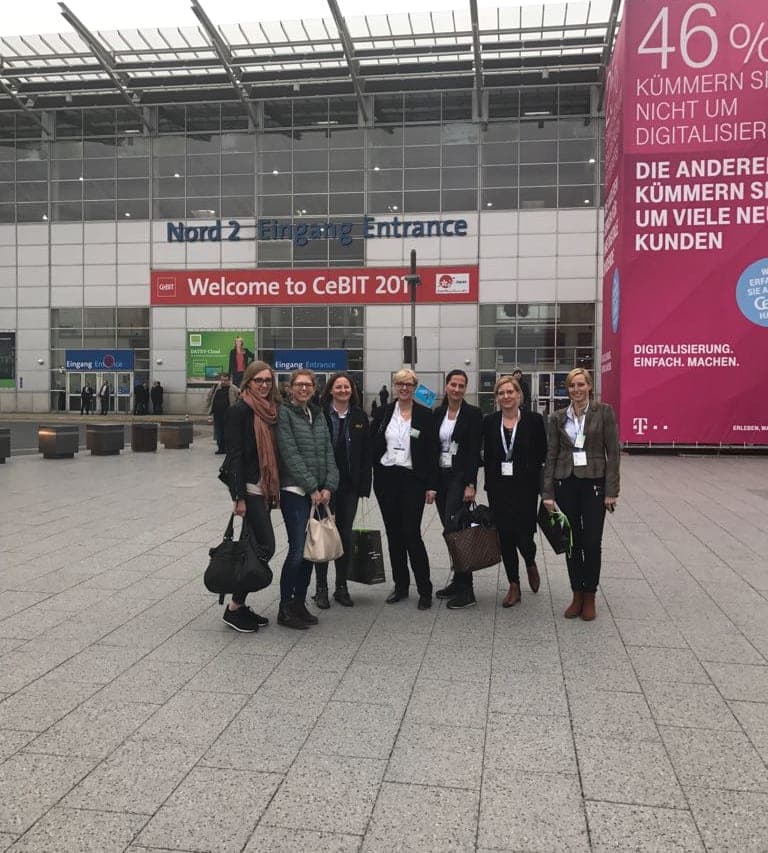


Looking at the colourful and impressive stands in the many halls of CeBIT, one might get the impression that our visit was serving our own abolition. Former printing and copying companies are suddenly becoming specialists in the paperless office, in scanning and in intelligent digitalisation — and on top of that, they cooperate with accounting programmes. Computer giant IBM welcomes us with Ollie, a self-driving bus that can even hold conversations with its passengers via the company's own Watson software and is, among other things, never at a loss for a restaurant recommendation. At the corner of the DATEV hall, a Kuka robot equipped with hardware and software support from Huawei plays the drums as if the goal were to abolish the profession of drummer. Passing by, we listen to the presentation of another accounting company that has just discovered voice control for itself. "Show me all invoices over EUR 300,000," the presenter requests — we are a little pleased that the software did not quite understand the question. But honestly, it is only a matter of time before this no longer limits the work (yours and ours).
Eight of us attended CeBIT: from payroll and financial accounting, from firm management and tax advisory, and from the partnership, Steffen & Partner had travelled to discover this new world from different perspectives and angles. The most important topics for us: IT security as well as digitalisation and the legally compliant retention of data. We came away with the impression that digitalisation will now genuinely raise — and is capable of raising — work productivity.
Indeed, we will be able to import a wide range of data into our DATEV systems more or less automatically from now on; basic reporting will become simpler; and entirely new reporting options are emerging from the "networked" data. In addition, it will become easier for you to transmit data to us. Starting in mid-year, there will be a scanning app that allows you to send images of receipts directly from your smartphone into your accounting at our office. Already today, you can scan your documents (or we can scan them for you), and our software recognises the text and proposes initial bookings. A self-learning system, incidentally — meaning that the more you scan, the more accurate the suggestions become.
Many things are still in the works. Some will arrive soon. In at least three areas we will expand our software to the benefit of our clients (interfaces/converters, reporting, document management). Where the question used to be simply how the shuttle folder gets from you to us and back, today it makes good sense for your IT manager to have a conversation with ours. And we will incorporate precisely this IT/data perspective into our procedural guidelines and our quality management. In future, new clients will only be onboarded after such a conversation has taken place; with our existing clients, we will hold these conversations gradually.
Our conclusion: we will not be abolishing ourselves any time soon. But the profile of our profession is changing; the extent of this change is still unclear, although the direction has been set. In this respect, the situation is no different from that of the past decades. What was, what is and what will be — our clients and we ourselves have been operating in this field of tension for over 30 years. The only tradition worth recognising and preserving is the movement from "was" to "will be," from the past to the future. We are looking forward to that, and our visit to CeBIT has confirmed it for us.
Frequently asked questions
Frequently asked questions
How can receipts be transferred to accounting via smartphone in the future?
Starting in mid-2017, a scanning app will be available that allows clients to transfer receipt images directly from their smartphone to their Steuerberater's (German Certified Tax Advisor) accounting system. This eliminates the need to physically deliver receipts and enables prompt processing. A connection to a digital accounting system such as DATEV is required.
How does automatic document recognition work in DATEV systems?
Scanned documents are read using optical character recognition (OCR), and the software automatically generates initial posting suggestions. The system is self-learning: the more receipts processed, the more accurate the suggestions become. This significantly reduces manual data entry.
What role does IT security play in digital collaboration with the Steuerberater (German Certified Tax Advisor)?
IT security is critical, as sensitive financial and personnel data are exchanged electronically between client and firm. We recommend that the IT officers on both sides jointly align data transmission paths, interfaces, and protective measures. Compliant data retention under GoBD must also be taken into account.
Why are tax firms introducing IT consultations before accepting new clients?
Digitalization is transforming data handover and requires coordinated technical processes. Before onboarding, the firm clarifies which systems, interfaces, and security standards the client has in place and how data exchange can be conducted efficiently and in compliance with GoBD (German Principles for Proper Bookkeeping in Electronic Form). Existing clients are also gradually integrated into this quality management approach.
In which areas does digitalising accounting deliver the greatest productivity gains?
Key benefits arise from automated data transfer from upstream systems, simplified reporting, and new analytics from integrated data. Document management and interfaces/converters between different programs also improve. This reduces routine tasks and frees up capacity for analysis and advisory work.