Today at 5:15 p.m., the traditional St. Martin's parade through downtown Bocholt takes place. St. Martin rides on his horse alongside a total of 16 Bocholt schools, accompanied by the organising board, guests and musical ensembles, moving through the centre of Bocholt.

The Bocholt St. Martin's parade. Image courtesy of the Heimatverein Bocholt.
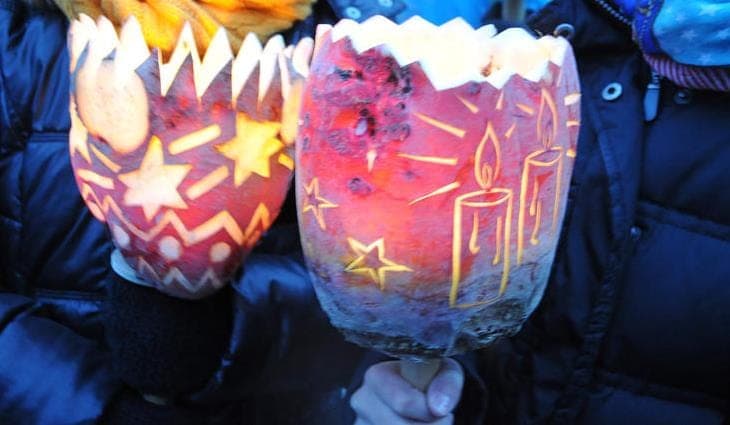
The Bocholt St. Martin's parade with its traditional beet lanterns, as depicted by the Heimatverein Bocholt. For all those interested — and incidentally, we find the Bocholt St. Martin's parade, one of the largest of its kind in Germany, both beautiful and well worth seeing — here is the route the procession will take:
Berliner Platz – forecourt of Mariengymnasium – Schleusenwallbrücke – Schanze, past the "Residenz" senior citizens' home – Brückenstraße – St.-Georg-Platz – Manes-Schlatt-Platz – Schanze, crossing left into Casinowall – Südwall – Osterstraße, crossing – Ostmauer – Nordmauer – Nordstraße, briefly – Niederbruch – Wesemannstraße – Langenbergstraße – Ostmauer, briefly – Osterstraße – Ostermarkt – Königstraße – Markt. The Verein für Heimatpflege, which organises the parade, welcomes donations (for a donation of €30 or more, you will receive a complimentary picture by the Bocholt artist Helga Wilms as a token of thanks). Further information and the Heimatverein's bank details can be found at: www.heimatverein-bocholt.de. By the way: in Bocholt, the so-called "Runkel lanterns" have a long tradition. The "Runkeln" (as they are called in Bocholt) are ordinary fodder beets, also known as sugar beets, Raahner, Rangasn, Rummel, mangelwurzel, Burgundy beet, sow beet, Dickwurz, Räben (in Switzerland) and many other names, depending on the region. These beets are then carved into (truly beautiful, glowing) St. Martin's torches. So far, so good. But the first time you sit down with your children to carve a lantern from a Runkel, you tend to look at it rather quizzically (at least that is what happened to us) and try to recall how you did it back in your own school days… and the memory, unfortunately, is no longer quite as vivid. Hmm — so what do we do in this day and age? Google it and check YouTube. But there is hardly anything to be found there — at least no really useful instructions. For us, the trouble began with figuring out which side should face up and which side gets screwed onto the cap or stick. So you stand there turning the heavy thing this way and that… and in the end, you have used the wrong side as the top after all.

Here she is – the Runkel beet – freshly washed and not yet a lantern. Of course we are working on a Bocholt BBV – but there are no instructions in there either…

Still in good spirits as she sets to work: our trainee Runkel specialist, Anke Büker. One thing is already certain – this is going to get chaotic…

Incidentally, a stubborn old Runkel is far tougher to work with than a pumpkin, and we have already hollowed out and carved quite a few of those.
Then we hollow out the beet with the children for all we are worth, and it takes ages. After that, we begin the carving: the children have wonderful ideas, which we love! But what we did not realise is just how difficult it is to actually translate those ideas into the carving. Our son immediately set to work on his own — after all, he is an artist. Oh dear, plenty of holes in the Räbli! It is not like a pumpkin: with a Runkel, you only "score" the surface, you do not "cut through"! Well, never mind — at least it was made by hand, and with looooots of love! The bishop is barely recognisable, the stars are 99% failures, suddenly everything starts turning brown while we are still carving, and because we also used the wrong side, it does not glow as beautifully red on top as we are used to. The hole becomes a goose, another becomes a star — it just keeps getting worse… Our daughter is nevertheless delighted (after a total of around four hours of work, after all there are two children and therefore two Runkeln) with the St. Martin's parade scene, which has been depicted on her Runkel with mixed success. Then a photo arrives from her cousin: the perfect Runkel — oh dear, could they not have shown us that beforehand? We are all rather amazed and have to admit, entirely without envy, that this Runkel is the most beautiful of them all. This Runkel can certainly hold its own.

The cousin's perfect Runkel

For anyone who cannot quite make it out: that is St. Martin on our daughter's Runkel

Hurrah: a breakthrough – our son carved his Runkel all by himself
No matter — the children still go to bed happy (it is the thought that counts and the shared experience, complete with St. Martin's songs; we still have the CD from kindergarten days… and… we love looking back on it). Mum clears up the chaos… still, by next year we will at least know (in theory) how it is done!!! And: by next year we will have put together a proper guide, we promise. We will publish it in good time in our magazine, so that other despairing parents fare better than we did. In any case, we wish all Bocholters (and everyone else coming to watch the parade) a wonderful time at today's St. Martin's parade. Afterwards, we will of course be enjoying — quite traditionally — roast goose, red cabbage and dumplings.
Frequently asked questions
Frequently asked questions
What are Runkel lanterns at the Bocholt St. Martin's parade?
Runkel lanterns are a Bocholt tradition in which fodder beets (regionally also called sugar beets, Rangasn, Rummel, Dickwurz or Räben) are carved into glowing Saint Martin's torches. Unlike a pumpkin, the beet is only partially carved and not hollowed through, so that the interior glows reddish from within. They are a characteristic feature of the Bocholt St. Martin's parade.
How does carving a fodder beet differ from carving a pumpkin?
The fodder beet is considerably harder and tougher than a pumpkin, making it more difficult to work with. Furthermore, the beet is not cut all the way through; instead, the motifs are only carved into the surface so that the thin wall glows red when illuminated. Holes that go right through are therefore considered a flaw.
Who organizes the Bocholt Saint Martin's procession?
The Bocholt city-center Saint Martin's procession is organized by the Verein für Heimatpflege (Heimatverein Bocholt). The association welcomes donations; for contributions of 30 euros or more, donors receive a picture by Bocholt artist Helga Wilms as a token of thanks. Further information and account details are available on the Heimatverein's website.
How large is the St. Martin's parade in Bocholt?
The Bocholt city-centre St. Martin's parade is one of the largest in Germany. Saint Martin rides on his horse through the city centre, accompanied by 16 Bocholt schools, the board of the local heritage association (Heimatverein), guests and musical groups.