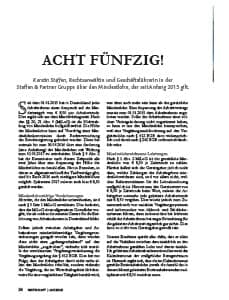
On the occasion of the VdU lecture "Recht verrückt und total besteuert", Kerstin Steffen was asked by the magazine VIER.SECHS.DREI. to summarise the key facts on the minimum wage. She was happy to do so, and the result is the article "Acht fünfzig!". Did you know, for example: "Whether allowances and supplements are to be credited against the minimum wage obligation must be assessed in a differentiated manner, following a reference by the Federal Government to the case law of the ECJ and the BAG on posted workers. According to this case law, such a payment by the employer is to be credited against the minimum wage obligation always, but only, if, according to its intended purpose, it serves as consideration for the work actually performed. Conversely, payments are not taken into account if they alter the relationship between the employee's "normal performance" and the wage to the employee's detriment. Accordingly, the following are not taken into account: allowances for quantitative or qualitative additional work, supplements paid for work at particular times of day and on Sundays and public holidays, rotating shift allowances, overtime supplements, and supplements for work performed under particularly arduous, burdensome or dangerous conditions. You can read the full article on the VIER.SECHS.DREI. website or directly here.  VIER.SECHS.DREI. "Acht fünfzig!" (PDF: 1.5MB)
Frequently asked questions
Frequently asked questions
Are allowances and bonuses credited against the statutory minimum wage?
This requires a differentiated view. According to the case law of the European Court of Justice and the BAG on posted workers, employer payments are only credited against the minimum wage if, by their intended purpose, they serve as consideration for the regular work performance owed. Payments serving a different purpose are not taken into account.
Which bonuses may not be credited toward the minimum wage?
Items that may not be credited include, in particular, allowances for quantitative or qualitative additional work, premiums for work at specific times of day or on Sundays and public holidays, rotating shift allowances, overtime premiums, and premiums for work performed under especially arduous, demanding, or hazardous conditions.
What criterion determines whether an employer benefit can be credited against the minimum wage?
The decisive factor is the purpose of the payment. If it compensates the regular, contractually owed work performance, it can be credited against the minimum wage. However, if it alters the balance between standard performance and wages to the employee's detriment — for example, by compensating additional hardships or overtime — crediting is excluded.
What was the statutory minimum wage in Germany at its introduction?
The statutory minimum wage was introduced at EUR 8.50 gross per hour and generally applies to all employees in Germany, unless a statutory exemption applies.